


LISTS
Exploring the Mystical Realms of Fantasy Synth
By
Louis Pattison
·
Illustration by
Karagh Byrne
·
August 25, 2025

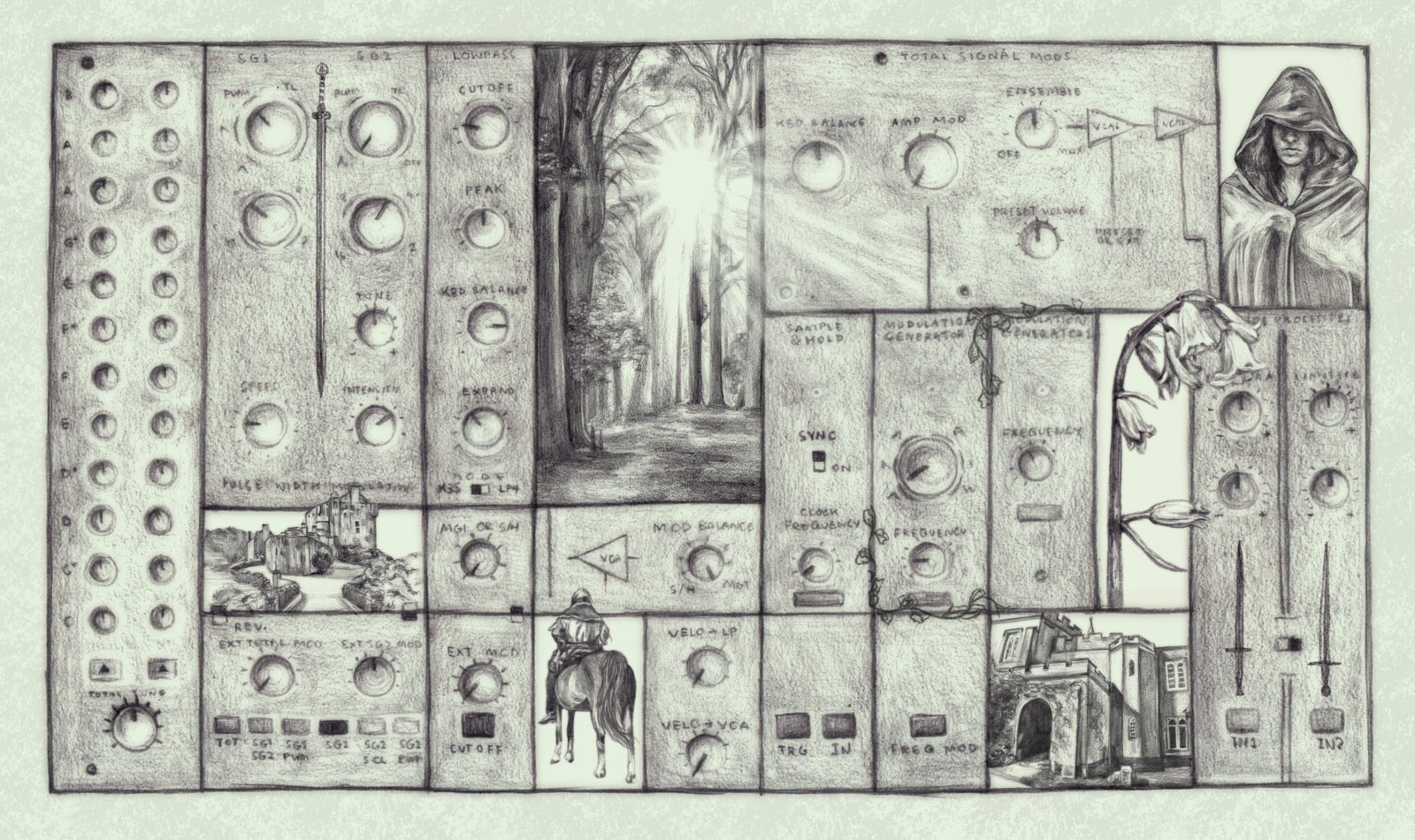
The resurgence of dungeon synth over the past decade or so has been something to behold. From a sparse scene of solo creators toiling away in hermetic isolation to a global community of thriving labels, sold-out festivals and international tours—truly, we are living in renaissance times.
But since the genre’s rebirth, there have been signs of a schism in dungeon synth circles—a philosophical disagreement between those who regard the genre as a fixed set of stylistic markers, and those who approach it as more of a conceptual playground to explore. In his comprehensive survey of the genre, Dark Dungeon Music: The Unlikely Story Of Dungeon Synth, author and Ancient Meadow Records founder Jordan Whiteman makes the case for dungeon synth as an inherently dark and melancholic sound, umbilically linked to the genre that spawned it: black metal. The book’s closing chapter identifies a wave of contemporary music that has been widely bracketed as dungeon synth, but that lacks that authentic “dark dungeon” feel. Whiteman anticipates his opinions will be dismissed as gatekeeping (and truth be told, it does come across a little that way), but you can kind of see his point. Take one of the acts he points to, Fief. Whiteman acknowledges the project’s originality and virtuosity, while noting that the music—a shimmering medieval fantasia that is noble, sometimes fanciful, but seldom particularly dark or grim—stands somewhat removed from dungeon synth’s recognized tropes. Perhaps the question is: Should we think of this gleaming, high fantasy-inflected sound as a new ripple in dungeon synth’s cloak, or is it something new springing into being?
There’s a term gaining currency to describe a wave of dungeon-synth-adjacent music that explores broader themes of mythology or make-believe: fantasy synth. Whereas classic dungeon synth is dark, dank and morose, fantasy synth explores a wider palette of sounds and emotions. It can be epic, wistful, playful, or bucolic. One common thread is that fantasy synth, through sound or presentation, seems to gesture towards a bigger, wider world—one that is both captured in, yet somehow exists beyond the music itself. “The tools of dungeon synth and fantasy synth are identical—from battle-worn Polysixes to enchanted VSTs. But the places they take you are different,” says Mercian Sam of the UK-based fantasy synth project Flickers From The Fen. “I think fantasy synth developed as a way to emphasize and expand on the mythical, whimsical, or Arcadian elements of dungeon synth that were always present, but often obscured by the gloom.”
Certainly, the line between dungeon synth and fantasy synth is porous. Fantasy themes have been a feature of dungeon synth since the beginning—particularly, the work of J.R.R. Tolkien, whose books and detailed world-building are in many ways inextricable from the broader fantasy genre to this day. Dungeon synth progenitors, including Summoning, Jim Kirkwood, and Secret Stairways drew inspiration from Tolkien’s work, and his influence persists today through contemporary projects such as Lug-Gastum, Frostgard, Anglachel, Old Toby, Ithildin, Crysalidis, and Hole Dweller.
Why has the influence of Tolkien been so pervasive? “I think it’s the passion and attention to detail for the world he built,” says Hole Dweller’s Tim Rowland, whose warm and bucolic music explores Tolkien’s Middle-Earth through the perspective of a wandering hobbit, Jamwine. “I always find it hard to get into the lore from other authors because it feels like so many just rehash the same tropes that Tolkien set forth. If I wanna dive into wizards, dwarves, elves, orcs, halflings and the like, there’s only one place I want to be.”
Survey the wider scene, though, and you’ll encounter dizzying variety. Think of a fantasy setting or a specific corner of mythology, and there’s almost certainly a one-person synth project out there taking its lore and turning it into music. To name but a few: Robert E. Howard’s Conan the Barbarian novels (Atlantean Sword); Dungeons & Dragons’s Forgotten Realms setting (Hillsfar); faerie lore (Achulean Forests, Faery Ring); HP Lovecraft (Voormithadreth, Cosmic Nightmares); Arthurian legend (Malfet, Pendragon); Ursula LeGuin’s Earthsea novels (Erreth-Akbe, Fogweaver); and the video role-playing game Runescape (Flickers From The Fen). Other musicians such as Quest Master, DIM, or Dungeontroll take a more homebrewed approach, creating their settings and lore from the ground up.
The Athens-based musician and mastering engineer Constantine Betsas started out making desolate dungeon synth under the name Ekthelion. But in 2019, he founded a new project, Arthuros, and began creating a cosmic fantasy style of his own design. “The brooding minimalism of Ekthelion began to feel like a sealed room,” he says. “I wanted to breathe more deeply, to explore wider emotional and imaginative landscapes. I think of Ekthelion as rooted in subterranean cathedrals and cursed ruins. Arthuros, by contrast, feels more like wandering starlit plains or forgotten temples under twin moons. It’s still escapist, but now the escape is toward the sublime, not just the shadowed.”
“I have recently stepped away from using ‘dungeon synth’ as a descriptor for what I do,” says Evergreen, a Portland-based musician who makes music under several pseudonyms, most notably the Ursula Le Guin-inspired Fogweaver. Evergreen is a trans woman—and let us not forget that the history of dungeon synth is dotted with projects like Burzum or Lamentation, whose music it is hard to extricate from their unpleasant politics. “There is ongoing discussion within the community of dungeon synth’s relation to black metal, which is something the genre seems forever tied to for better or for worse,” she continues. “I’d rather dream beyond that and imagine new worlds. ‘Fantasy synth’ feels more liberating in that regard. It’s bogged down less by history and problematic figures. It has more room to grow and evolve and become something different.”
Before we run down a list of notable fantasy synth creators, let’s first set down some definitions. Here, we’ll use fantasy synth to refer to music that meets three criteria. It is electronic music, created by solo artists, using simple digital tools. It largely eschews the “dark dungeon” style established by Mortiis in favor of something lighter and more fanciful. And it engages in some way with the imagery and lore of high fantasy—be that of an existing creator or franchise, or inventing their own setting from scratch.
These are humble songs, hewn from the gleaming face of a digital audio workstation. But in them, we hear epic battles rage, grand feats of heroism and treachery, empires rise and fall.
Now, let us enter the realm of fantasy synth.
“My brain has been pickled in medieval fantasy, and that’s what wants to come out,” says the anonymous figure behind Fief. From his base in Salt Lake City, he creates music under several pseudonyms, including Sequestered Keep and the more quintessentially “dark dungeon music” project Thangorodrim. But it’s the music that he makes as Fief that seems to have resonated most, and perhaps stands as the pinnacle of fantasy synth as a genre.
“The swords-and-castles variety of escapism has always appealed to me,” he continues, reeling off a list of conceptual influences: “Arthurian legend, various mythologies, folklore, and regional fairytales. Chaucer, of course. Lord Dunsany, Tolkien, Mervyn Peake, Gene Wolfe. Sword and sorcery stories by Howard, Fritz Lieber, Michael Moorcock, C.L. Moore, Poul Anderson, Karl Edward Wagner.” He points in particular to a passage from The Jester, an early 20th-century fantasy novel by Leslie Moore in which the protagonist, Peregrine—a young man who has inherited the role of court jester from his father—sings to the noble Lady Isabel for the first time. “Whose are the words?” she asks. “Madam, they come from realms of fancy,” he responds.
Fief’s music isn’t tied to any explicit lore, but his compositions paint vivid pictures—sometimes noble and courtly, other times playful and whimsical—with shimmering melodies seemingly picked out on a lyre or harpsichord. Every one of Fief’s six albums to date is worth a listen, but II in particular seems to hold a special place in the heart of fans: an idyllic fever dream that peaks with “In the Secret Glade of the Shy Dragon”.
“When first writing for Quest Master, I always pictured each song representing a level in an old fantasy RPG, imagining the track as the backing music for that level,” explains Lord Gordith. But after four albums of stellar, fantasy-inflected dungeon synth, the Australian producer decided it was time to take the project in a new direction. 2023’s Sword & Circuity marked a bold shift in tone—a sleek fusion of dungeon synth and ’80s synthwave, powered by glossy FM synths and pulsating drum machines. It introduced a striking new visual aesthetic too, one that melds medieval fantasy with the near-future sci-fi of films like Blade Runner and The Matrix.
For the follow-up, 2025’s Obscure Power, Gordith collaborated with his girlfriend to further develop the project’s lore. Track titles like “Silicon Rainforest” and “Ethereal World Plaza” could have been lifted from a William Gibson novel. Indeed, Gibson famously described his fiction not as prophecy but as a lens through which to interpret the present, and the same might be said of Quest Master’s music. “We often find ourselves controlled by the dark forces of the corporate world,” says Gordith. “The Obscure Power is the unseen force that makes us conform to the established natural order of the modern world. The music represents the striving to break away from the constraints of that power.”
“Almost every album I’ve ever done has been a concept album, whether it be based on my own inner worlds or worlds made carefully by other makers,” explains Josiah Wilkinson. Working under the name DIM, Wilkinson has racked up a run of outstanding releases in the field of what he calls “sacral medievalist electronics.” DIM’s early trilogy Compendium showcased a baroque fantasy synth sound that explored a loose homebrew fantasy narrative following the adventures of a character known as the nameless minstrel. Later albums, such as Steeped Sky, Stained Light, and Parachrism delve into the spiritual and bear the influence of ambient music and trance. “Setting is the most important aspect of music to me—meaning where the music puts the listener,” adds Wilkinson. “I consider that deeply with each album, and my original text, stories, and loose narratives are purely for that purpose.”
Alongside DIM, Wilkinson also operates the label Lowly, Dying Steward, which has become a reliable source of fantasy music of an idiosyncratic bent. “I wanted an outlet for bold fantasy-inspired music that did not necessarily hold to the sound palette of early dungeon synth, like so many do, but break away, taking the road less traveled,” he explains. Highlights of the label to date include Chronicles of the Mystic Coop, a so-called “chicken synth” collaboration between Wilkinson and Joshua Love of Iosu, and Eternal Winds of Ash & Ice, a stirring synthesized fantasy music by Hellige—aka Wilkinson’s partner and collaborator, Hannah Wilkinson.
Across several albums under the name Arthuros, Constantine Betsas has gradually refined his dramatic, celestial sound in songs that feel cosmic in scope—part medieval fantasy, part swashbuckling space opera. “I’ve always had a deep love for the aesthetics of ‘80s fantasy films like Legend (1985) and Excalibur (1981),” he explains. “They’re rooted in the medieval, yes, but shot through with something unearthly and ethereal.”
This year’s Travelstar marks Betsas’s fifth journey under the Arthuros name. Sounding like dungeon synth by way of Vangelis, the album’s seven tracks trace out a heroic journey that draws on philosophy and mythology. “I grew up immersed in Greek and European myths, as well as mythologies from across the world, and all of that informs the inner world of Arthuros,” says Betsas. “I’m a great admirer of Carl Jung, and his ideas about archetypes and the collective unconscious resonate deeply with me.”
“At its heart, Arthuros is driven by the idea of the sacred quest—not in a moral or heroic sense, but an existential one. The hero isn’t always triumphant. Sometimes they vanish into fog, or become a ghost in someone else’s legend. But they keep walking. That’s the emotional compass. The hero ends up with what he truly needs, not what he thought he wanted.”
Flickers From The Fen are behind one of the most entertaining live shows in the wider dungeon synth milieu: A mini-ensemble of drums and French horn, with sprightly leader Mercian Sam stepping out into the crowd to saw out jaunty melodies on his violin, face covered by an oversized wizard’s hat. Their two albums to date, Stoned In Gielinor and Stoned In Gielinor II, draw their concept from Sam’s childhood adventures on RuneScape, a fantasy MMORPG—massively multiplayer online role-playing game—that captivated a generation of gamers in the early ‘00s. But Flickers From The Fen’s often wistful and nostalgic music isn’t so much a straightforward tribute to those games as a nod to the way that fantasy and folklore can cast a spell on us that lingers in our imagination.
“For me, fantasy is about being enchanted in your everyday life,” says Sam. “That can be something simple, like turning daily errands into an epic quest. But it can also be more mysterious, like the way we walk through a landscape differently once we know the local folklore that comes from it. Or how we never quite disbelieved an elderly family member who swore they saw faeries at the bottom of the garden when they were young. As an artist, capturing these moments can be a challenge—they deal with feelings that can be as grandiose as they are ephemeral. But it’s always a joy to try and bottle a walk through the woods in a tune, or turn childhood memories of late-night RPG sessions into an audio portrait.”
“Fantasy, for me, is on one hand an escape or a refuge,” says Evergreen. “On the other hand, it is a tool by which we can examine our world differently. Fantasy has been something which has helped me process a lot of hardship in my own life—it has provided insight and lessons and new context to the world in ways realism could not for me.” Evergreen’s project Fogweaver is conceptually rooted in an existing fantasy world—Ursula LeGuin’s high fantasy series Earthsea. “A friend of mine told me that the books had deep insights as well as [taking place in] an enchanting world,” explains Evergreen. “By the time I’d read them, I was absolutely engrossed. They helped me through some of the worst times in my life—and honestly, they continue to help me to this day with each re-read.”
By and large, Evergreen says, she tends not to compose with particular stories or passages in mind, preferring to focus on more general feelings or themes she finds in the books. But her melancholic 2022 album Labyrinthine drew heavily from Le Guin’s second Earthsea book, the gloomy coming-of-age tale The Tombs of Atuan. “It was somewhat of an unconscious expression of the deep connection I have to the story of the book,” she explains. “I ended up channeling some feelings into that album regarding the processing of my own identity, as the book resonates with me as somewhat of an unintentional trans allegory. I like to leave things open-ended for listeners to interpret in their own way, but Earthsea is the jumping-off point.”
Nouvelle-Aquitaine, France
Nouvelle-Aquitaine, France
John Lordswood has been a central figure in the revival of dungeon synth. From his home base in Nouvelle-Aquitaine, France, Lordswood has written zines, organized events, acted as archivist on The Dungeon Synth Archives YouTube channel, and worked across a string of record labels, most recently his own Ancient King Records. Alongside that, he works as a graphic designer and sound engineer, and also operates several fantasy synth-ish projects: the dreamy, cosmic Weress; the bucolic, medieval Iskonge; the epic, brooding Flamberge. But asked for the project he feels most accurately fits the fantasy synth bracket, he opts for his Ancient Egyptian-inspired solo project Skhemty.
“The music itself is meant to feel like it belongs to a specific world from Egyptian mythology,” explains Lordswood. “I’m curious that many don’t explore this universe enough with dungeon synth, because it’s something that I find deeply inspiring as a way to tell or imagine stories, to use different medieval-age instruments, or the beautiful oriental scales you can discover while composing. In some cases, I also draw from existing fantasy literature from Egypt, such as novels about cursed mummies, historical and archaeological books, or The Book of the Dead.”
Lordswood describes the process of creating a sort of “unwritten mythology” through Skhemty, “something that feels like it has a history, even if it’s only suggested through sound.” That sense of an implied lore, a wider world beyond the music, is what distinguishes fantasy synth from dungeon synth, he believes. “It’s not so much a sub-genre—it’s more world-building.”
“I’ve always had an affinity toward Hobbits, and I’m not sure exactly why,” says Tim Rowland of Hole Dweller. “It could’ve been back before I ever read the books. I watched the animated Hobbit film from Rankin/Bass, and as the viewer, I identified with Bilbo the most. When Gandalf and the dwarves first start arriving at his home, it feels as alien to us as it does to Bilbo. The reader and Bilbo—or even Frodo in Lord of the Rings for that matter—share in discovering these totally new events, characters, and locations for the first time.”
Later, Rowland discovered the Lord of the Rings online game, in which he’d play as his own invented character, a Hobbit by the name of Jamwine. These gaming sessions had a direct influence on the composition of his earliest work as Hole Dweller. “When I wrote the first album [2019’s Flies The Coop] I actually had the game up in one window and my DAW in the other,” says Rowland. “I walked him to the locations the story followed, sat there in-game, and played my keyboard. It was easy to immerse myself in the world because I was staring at a version of it while I wrote.”
Jamwine, explains Rowland, has been central to his music as Hole Dweller ever since. “He’s kinda like a chess piece that I can move into a variety of locations that color the compositions, depending on where he lands,” he says. “For the most part, he stays within the bounds of The Shire—with the exception of Flies the Coop 2, where he takes a dwarven caravan into the Ered Luin region and all hell breaks loose near the end. He quickly makes his way back safely to The Shire after all that drama with the help of others, of course. Not quite as epic a tale as that of Bilbo or Frodo, but certainly a lot more than any Hobbit’s desire for adventure.”
Wyrm is surely one of the most prolific creators in dungeon synth. Proprietor of the label Serpents Sword, he’s released over 100 albums under a string of pseudonyms, including Erythrite Throne, Cefaris, Elder Goblin, Frailord, and Dungeontroll.
It’s with Dungeontroll that Wyrm leans most explicitly into fantasy themes. The project’s dozen or so releases to date explore a sweeping instrumental sound, each one packaged in artwork that resembles the jackets of ‘80s fantasy paperbacks—gleaming hilltop kingdoms, brave knights slaying despicable bog monsters, a satyr playing his pipes on the banks of a still lake. “I’ve loved these kinds of stories since I was a kid,” enthuses Wyrm. “I have great memories of going to local video shops and renting The Dark Crystal, Legend, Conan the Barbarian. The stories and soundtracks to these films—as well as some of the earlier dungeon music that veered a bit into the fantasy realm, like Fata Morgana, Corvus Neblus, and era-I Mortiis—really hypnotized me and inspired me to make my own little world.”
Some of Wyrm’s projects, like Dungeontroll and Elder Goblin, inhabit the same fictional world of Uzohr—a domain of Wyrm’s own creation. “It’s hard for me to describe the lore in words,” he says, “but I hope those who listen to the music can understand and feel the emotion put into these releases. I see it as a world of danger and peace, of death and rebirth, of adventure and sorrow. These are the stories I want to tell with these projects. Stories of hope, stories of despair, stories that you can feel in your soul.”
link